Integrating the Contour Plastic Icon into Professional Design Workflows
In the fast-paced environment of digital design and content creation, visual consistency is often the differentiator between amateur and professional output. The Contour Plastic icon serves as a specialized asset within cosmetology and medical aesthetics collections, providing a clean, monochrome symbol that communicates complex procedures without visual clutter. For web designers, marketers, and clinic owners, this vector graphic is not merely a decorative element; it is a functional component of user interface design, patient education materials, and brand identity systems. Understanding how to leverage this specific icon requires looking beyond its aesthetic appeal and focusing on its technical integration, scalability, and role in broader communication strategies.
Defining the Asset and Its Technical Foundation
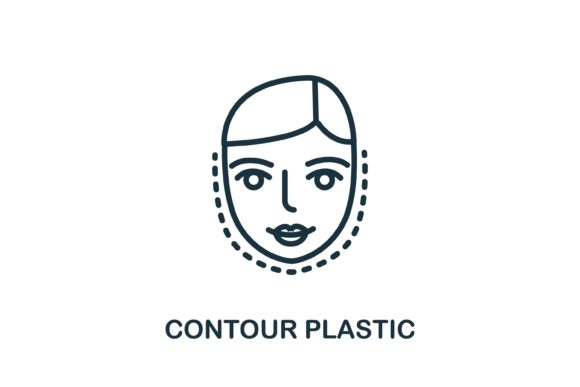
The Contour Plastic icon represents a specific category of non-surgical facial enhancement. In a design context, it functions as a semantic signifier, allowing users to instantly recognize services related to dermal fillers, jawline definition, or structural rejuvenation. The "monochrome" specification is critical for workflow efficiency. Unlike full-color illustrations that may clash with varying brand palettes or background colors, a single-color vector allows for universal application. This neutrality ensures the icon remains legible whether placed on a dark mode website header, a printed brochure, or an Instagram infographic template.
Technical versatility stems from the file formats provided. Access to both EPS and JPG files addresses distinct phases of the production cycle. The EPS (Encapsulated PostScript) file is the master source. It contains mathematical path data rather than pixels, meaning it can be scaled to the size of a billboard or shrunk to a 16-pixel favicon without losing edge definition. This format is essential for print production and high-resolution display screens. Conversely, the JPG file serves as a rapid-deployment asset for mockups, internal presentations, or platforms that do not support vector rendering. Having both formats immediately available eliminates the need for rasterization or tracing, saving significant time during the initial layout phase.
Pre-Project Planning and Asset Organization
Effective implementation begins before the design software is even opened. When planning a cosmetology website or marketing campaign, the Contour Plastic icon should be categorized within a structured asset library. Professionals working with extensive icon sets must establish naming conventions and metadata tags early. Labeling this asset clearly—for example, icon-contour-plastic-mono.eps—prevents confusion with similar symbols like general syringes or lip augmentation icons. This organizational step is vital for teams where multiple designers access shared resources, ensuring that the correct visual metaphor is selected consistently across different touchpoints.
During the planning stage, consider the icon’s weight and stroke width relative to other elements in your system. If you are building a comprehensive cosmetology collection, the Contour Plastic icon must share the same optical weight as icons representing skincare, laser treatments, or consultation services. Before finalizing layouts, test the icon at various sizes. A detailed contour illustration might look elegant at 200 pixels but could become illegible mud at 32 pixels. Establishing minimum size requirements during the planning phase prevents usability issues later in the development process.
Execution: Editing and Customization Workflows
The "easy to edit" nature of the EPS file is its primary operational advantage. Most professional workflows require adapting stock assets to match specific brand guidelines. Using vector editing software such as Adobe Illustrator, Affinity Designer, or CorelDRAW, you can modify the Contour Plastic icon to align perfectly with your project’s visual language. This customization goes beyond simple color changes. You may need to adjust stroke caps, simplify anchor points for better web performance, or combine the icon with typography to create a composite logo lockup.
When integrating this symbol into web templates, consider the export pipeline. While the source is EPS, modern web workflows typically utilize SVG (Scalable Vector Graphics). Converting the EPS to an optimized SVG reduces file size and allows for CSS manipulation. This means you can animate the icon on hover, change its fill color based on user interaction, or ensure it inherits the current text color automatically. For infographics, the monochrome design allows you to use color coding strategically. You might keep the icon black for standard information but switch it to a warning red or success green to indicate contraindications or positive outcomes, all while maintaining the same base shape.
Application Across Digital and Print Mediums
The utility of the Contour Plastic icon spans multiple deliverables, each with unique technical constraints. In web design, it often serves as a navigation aid or a feature highlight on service pages. Here, clarity is paramount. The icon should be paired with concise copy that reinforces its meaning, reducing cognitive load for visitors seeking specific treatments. For e-commerce or booking platforms, it acts as a visual filter, helping users quickly locate relevant services without reading dense text blocks.
In educational contexts, such as patient consent forms or pre-procedure guides, the icon provides visual anchoring. Medical and aesthetic information can be overwhelming; breaking up text with familiar symbols improves comprehension and retention. The monochrome style is particularly advantageous here, as it maintains a clinical, sterile aesthetic appropriate for medical documentation without distracting from the critical safety information. For social media templates, the vector format allows creators to resize the asset dynamically for stories, posts, and reels without maintaining multiple versions of the same graphic.
Quality Control and Consistency Checks
Maintaining quality requires systematic review. After placing the Contour Plastic icon in a layout, verify its alignment with the grid system. Misaligned icons create subconscious friction for users and degrade perceived professionalism. Check contrast ratios against backgrounds to ensure accessibility compliance; a light gray icon on a white background may fail WCAG standards, making the content inaccessible to visually impaired users. Because the asset is monochrome, adjusting opacity or adding a subtle drop shadow can sometimes improve separation from busy backgrounds without compromising the minimalist aesthetic.
Consistency also extends to stylistic coherence. If your project uses rounded corners on buttons and containers, ensure the Contour Plastic icon does not feature sharp, aggressive angles that contradict the softer UI elements. Conversely, if the design language is geometric and precise, a hand-drawn version of this icon would feel out of place. Regular audits of your icon usage help identify drift over time, especially in long-term projects where multiple contributors may have interpreted the asset differently.
Long-Term Asset Management and Scalability
Sustainable design practices involve thinking about future use cases. The Contour Plastic icon should be stored in a centralized digital asset management (DAM) system or a cloud-based library accessible to all stakeholders. Documenting any modifications made to the original EPS file is crucial. If you created a simplified version for mobile displays or a reversed-out version for dark backgrounds, save these as separate, clearly labeled derivatives. This prevents future designers from having to recreate work that has already been done.
As trends evolve, the ability to update the icon without starting from scratch becomes valuable. Perhaps the industry shifts toward more abstract representations, or your brand undergoes a refresh. Because you possess the editable vector source, you can adapt the Contour Plastic icon to new styles while retaining its core recognition factor. This longevity maximizes the return on investment for the asset. Furthermore, keeping the original EPS file archived ensures you always have a pristine master copy to return to, protecting against quality degradation that occurs when repeatedly saving rasterized formats.
Strategic Integration in Business Communication
Beyond pure design, this icon supports business objectives by streamlining communication. For entrepreneurs and small business owners in the aesthetics space, clear visual signaling reduces administrative overhead. When clients can self-identify their needs through intuitive iconography on a website or price list, they arrive at consultations better informed and more confident. This efficiency translates directly to higher conversion rates and smoother operational flow.
For educators and trainers, the icon serves as a standardized reference point. Creating training manuals or certification materials requires consistent terminology and visuals. Using a recognized, professional-grade Contour Plastic icon establishes credibility and helps students associate specific visual cues with procedural knowledge. In this context, the asset is not just a graphic; it is a pedagogical tool that reinforces learning outcomes and standardizes industry vocabulary.
Ultimately, the value of the Contour Plastic icon lies in its seamless integration into professional workflows. It bridges the gap between artistic expression and functional communication, providing a reliable, scalable, and editable solution for a niche but growing market. By treating it as a systematic component rather than a standalone decoration, professionals can enhance usability, maintain brand integrity, and deliver superior experiences across all mediums. Whether used for a quick social media update or a comprehensive rebranding effort, mastering the practical application of this vector asset is a fundamental skill for modern creators in the cosmetology sector.